
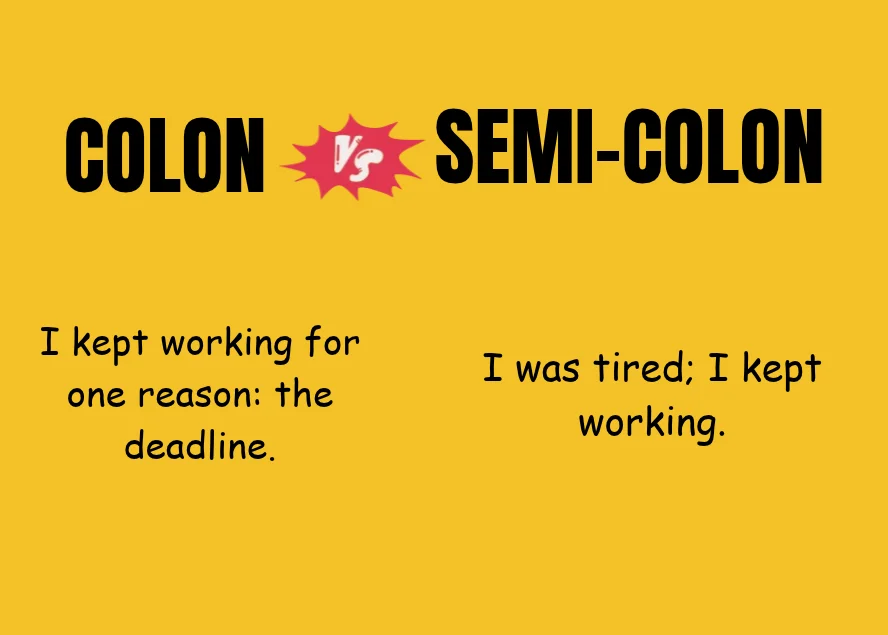
The core difference in Colon Vs Semicolon usage is this: a colon (:) introduces something — a list, an explanation, or an example — while a semicolon (;) connects two complete, closely related sentences without needing a conjunction like “and” or “but.”
Quick Reference Table: Colon Vs Semicolon At a Glance
| Particulars | Colon (:) | Semicolon (;) |
|---|---|---|
| Main Job | Introduces a list, explanation, or example | Connects two related complete sentences |
| Can It Replace “Because” or “Such As”? | Yes, functionally | No |
| Capitalization After (US) | Often capitalized if a full sentence follows | Lowercase, unless a proper noun follows |
| Capitalization After (UK) | Lowercase, unless a proper noun follows | Lowercase, unless a proper noun follows |
| Works With Lists? | Yes, this is one of its main jobs | No, not typically |
| Joins Two Full Sentences? | Sometimes, for dramatic emphasis | Yes, this is its core purpose |
| Formality | Slightly more direct, common in headlines | Slightly more literary, common in formal writing |
How Each Mark Works
What Is a Colon?
A colon tells the reader that something related is coming next. The part before the colon should be able to stand alone as a sentence. The part after it gives more detail.
She packed only the essentials: a passport, a charger, and a toothbrush.
The first part is a full sentence. The colon announces the list that follows.

What Is a Semicolon?
A semicolon works like a soft period. It connects two complete sentences when the ideas are tightly linked, and it keeps the reader moving instead of stopping fully.
The meeting ran long; nobody wanted to leave.
Each side of the semicolon could be its own sentence. The semicolon shows that the two ideas belong together.
Colon Usage Rules
Rule 1: Introduce a List
Use a colon after a complete statement to introduce a list.
You will need three things: a pen, a notebook, and a timer.
Rule 2: Introduce an Explanation or Example
When the second part explains, expands, or gives the reason for the first, a colon fits well.
He had one goal: finish the race.
Rule 3: Introduce a Quotation
A colon can lead into a longer or more formal quotation.
The sign said it plainly: “Please do not touch the exhibits.”
Rule 4: Write Time, Ratios, and Titles
Colons also appear in other fixed formats.
| Use | Example |
|---|---|
| Time | 3:30 p.m. |
| Ratio | 2:1 |
| Title and subtitle | Writing Well: Short Lessons in Clear English |
| Business letter greeting | Dear Ms. Carter: |
Rule 5: Do Not Put a Colon Right After a Verb or Preposition
A colon should follow a complete clause. Placing it in the middle of a sentence, directly after a verb or a preposition, breaks that pattern.
| Incorrect | Correct |
|---|---|
| I need: eggs, milk, and bread. | I need three things: eggs, milk, and bread. |
| She is good at: writing and editing. | She is good at two things: writing and editing. |
| I need eggs, milk, and bread. | (No colon needed. The sentence flows without one.) |
Capitalization After a Colon
In American English, style manuals differ slightly. A common approach is to keep the word after a colon lowercase when it begins a phrase or a single sentence, and to capitalize it when it starts a proper noun or when more than one full sentence follows. If you write for a school, publisher, or employer, check its style manual.
Semicolon Usage Rules
Rule 1: Join Two Related Independent Clauses
Use a semicolon when two complete sentences are closely connected and you want them in a single sentence.
I love hiking; my brother prefers swimming.
Rule 2: Use a Semicolon Before Words Like However and Therefore
When a word such as however, therefore, moreover, or for example links two complete clauses, put a semicolon before it and a comma after it.
The train was late; however, we still made the show.
Rule 3: Separate Items in a List That Already Has Commas
When list items contain commas of their own, semicolons keep the groups clear.
The team has offices in Austin, Texas; Denver, Colorado; and Portland, Oregon.
Rule 4: Do Not Use a Semicolon Where a Comma Belongs
A semicolon needs a complete clause on both sides. If one side is only a fragment, use a comma or rewrite.
| Incorrect | Correct |
|---|---|
| Although it rained; we went outside. | Although it rained, we went outside. |
| I like pizza; and pasta. | I like pizza and pasta. |
| She called; because she was worried. | She called because she was worried. |
Colon Vs Semicolon Vs Comma
The comma is the most flexible mark, and it is the one people often swap by mistake. Joining two complete sentences with only a comma creates an error called a comma splice.
| Mark | Best Used For | Example |
|---|---|---|
| Comma (,) | Short pauses, lists, and joining clauses with and, but, or | I was tired, but I kept working. |
| Semicolon (;) | Joining two complete, related sentences without a conjunction | I was tired; I kept working. |
| Colon (:) | Introducing a list, explanation, or quote | I kept working for one reason: the deadline. |
Colon Vs Semicolon: American vs British English
Here’s a genuine, well-documented difference worth knowing, especially if you’re writing for a specific regional audience. The core grammatical rules for Colon Vs Semicolon usage are essentially identical between American and British English — the real difference shows up specifically in capitalization after a colon, not in when each mark gets used.
| Rule | American English | British English |
|---|---|---|
| Capitalize after a colon, if a full sentence follows | Often capitalized, depending on style guide | Typically lowercase |
| Capitalize after a colon, before a proper noun | Capitalized | Capitalized |
| Capitalize after a semicolon | Lowercase (unless a proper noun follows) | Lowercase (unless a proper noun follows) |
Common Mistakes People Make With Colon Vs Semicolon
A few mix-ups come up constantly, even among confident writers.
- Using a colon after an incomplete sentence: “My favorite foods are: pizza, pasta, and bread.” (Incorrect — remove the colon, since “my favorite foods are” isn’t a complete thought on its own.)
- Using a semicolon to introduce a list: “Bring these items; a notebook, a pen, and water.” (Incorrect — this needs a colon, not a semicolon.)
- Treating a semicolon like a comma: Semicolons need a complete sentence on both sides; a comma does not require that.
- Forgetting the conjunctive adverb rule: Writing “I was tired, however I kept working” instead of the correct “I was tired; however, I kept working.”
- Overusing colons for drama: Leaning on a colon in every other sentence for emphasis quickly makes writing feel exhausting rather than punchy.
Short Conversation Examples
These sample messages are invented to show usage. They are not real user messages.
Maya: I always mix these two up. Which one goes before a list?
Jordan: A colon, as long as the sentence before it is complete. “I packed three things: a hat, a book, and water.”
Jordan’s reply shows the colon introducing a list after a complete clause.
Sam: Is this right? “I was late; the bus broke down.”
Priya: Yes. Both halves are complete sentences, and they are closely linked, so a semicolon works.
Priya confirms the semicolon joins two related independent clauses.
Colon Vs Semicolon in Different Contexts
Academic and Professional Writing
Both marks appear in essays, reports, and formal emails. Colons are common for introducing lists, definitions, and key points. Semicolons help connect related ideas without starting a new sentence, but they work best in moderation. Too many can make writing feel heavy.
Casual Writing and Texting
In texts and social posts, many people skip semicolons and use periods or dashes instead. That is a style choice, not an error. Colons still show up in informal lists and in emoticons.
Semicolon and Colon in Emoticons
In emoticons, a colon usually forms the eyes of a face, as in 🙂 or :(, and a semicolon forms a winking face, as in ;). The tone depends on context, so do not read too much into a single wink.
25 Example Sentences Using “Colon Vs Semicolon”
- I need three things for the trip: clothes, shoes, and a jacket; my bag is already packed.
- She had one goal: to win the competition; she practiced every day.
- We visited three cities: Delhi, Jaipur, and Agra; each place was beautiful.
- He knows the answer: the meeting starts at nine; everyone should arrive early.
- I bought everything I needed: milk, bread, and eggs; the store was closing soon.
- There was only one problem: the car would not start; we had to call a mechanic.
- She loves outdoor activities: hiking, cycling, and swimming; her brother prefers indoor games.
- The teacher gave us good advice: study regularly; avoid waiting until the last minute.
- I have two plans for the weekend: visit my family; stay home and relax.
- He made a simple promise: he would never give up; he kept that promise.
- We need several items: notebooks, pens, and folders; the new semester begins tomorrow.
- She had one favorite hobby: painting; she spent most of her free time creating art.
- There are two ways to reach the village: take the bus; drive your own car.
- I learned an important lesson: patience is valuable; rushing often causes mistakes.
- The recipe requires four ingredients: flour, sugar, eggs, and milk; the cake takes about an hour to bake.
- He had one request: keep the door closed; the room needed to stay quiet.
- We planned everything carefully: the location, food, and decorations; the event went smoothly.
- She wanted only one thing: a peaceful evening; she turned off her phone and relaxed.
- The shop sells many products: clothes, bags, and accessories; its prices are reasonable.
- I have a few hobbies: reading, photography, and traveling; they help me relax.
- He gave us a clear warning: do not touch the machine; it can be dangerous.
- There was one reason for the delay: heavy traffic; we arrived thirty minutes late.
- My daily routine is simple: exercise in the morning; read before going to bed.
- She packed the essentials: her passport, wallet, and phone; then she left for the airport.
- The message was clear: everyone must attend the meeting; no exceptions were allowed.
Conclusion
At the end of the day, Colon Vs Semicolon isn’t nearly as confusing as it first seems once you know what each mark is actually doing. A colon announces something coming next — a list, an explanation, a reveal. A semicolon links two complete, closely related sentences that feel too connected to separate with a period. Run the simple test — does a full sentence follow? — and you’ll get it right almost every time. The only genuine regional wrinkle worth remembering is colon capitalization, which shifts slightly between American and British English, while semicolon rules stay consistent across both.
Read More:
- Affect or Effect
- Gray or grey
- Ween or Wean
- Alot Or A Lot
- Forty Or Fourty
- Is Tomato A Fruit Or Vegetable
- Leaped Or Leapt
- Soccer Vs Football
Frequently Asked Questions
1. What is the main difference between a colon and a semicolon?
A colon introduces something, like a list or explanation, while a semicolon connects two complete, closely related sentences without needing a conjunction.
2. When To Use A Colon Vs Semicolon in a list?
Use a colon to introduce a simple list. Use a semicolon only when the list items themselves already contain commas, to avoid confusion.
3. Does Colon Vs Semicolon usage change between American and British English?
The core usage rules stay the same. The real difference is in capitalization after a colon, which is more common in American English than in British English.
4. Can a semicolon replace a colon before a list?
No. A semicolon should not be used to introduce a list; that’s specifically a colon’s job.
5. What is a simple trick to remember Colon Vs Semicolon rules?
Check whether a complete sentence follows the punctuation mark. If not, use a colon. If a full, related sentence follows, a semicolon usually works.
We hope you found the perfect name! For more inspiring name ideas and their meanings, explore Word Meaning Zone.
