
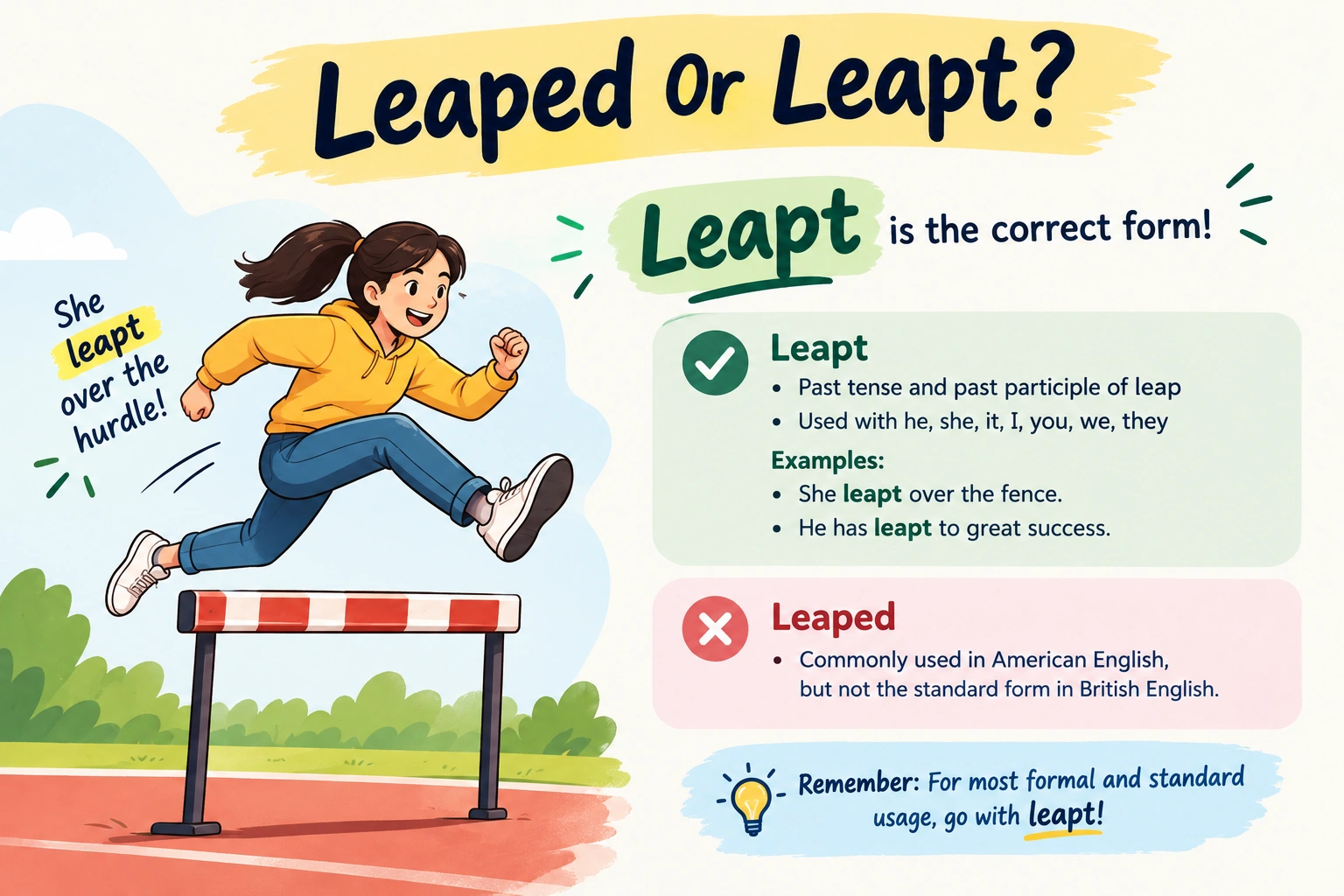
Both Leaped Or Leapt are correct — they’re simply two accepted past tense spellings of the verb “leap,” with “leaped” preferred in American English and “leapt” preferred in British English.
Quick Reference Table: Leaped Or Leapt At a Glance
| Particulars | Details |
|---|---|
| Base Verb | Leap (to jump, hop, or spring quickly) |
| Past Tense Forms | Leaped, Leapt (both correct) |
| Preferred In | Leaped — American English; Leapt — British English |
| Pronunciation (Leaped) | Rhymes with “reaped,” “peeped,” “beeped” |
| Pronunciation (Leapt) | Rhymes with “kept,” “slept,” “wept” |
| Past Participle | Both “leaped” and “leapt” work |
| Formal Tone | Leapt often reads as slightly more literary |
| Dictionary Status | Both appear in Merriam-Webster and Oxford |
What Does “Leap” Actually Mean?
Before untangling Leaped Or Leapt, let’s make sure the base word itself is clear. “Leap” means to jump, hop, or move quickly and suddenly, often covering a fair distance in the process. It can be used literally — someone leaping over a puddle — or figuratively, like a business that “leaps” into a new market, or your heart “leaping” with excitement.
The past tense of this verb is where things get interesting, because English gives you two equally valid options: leaped and leapt. Neither is a typo, neither is “more correct” than the other, and neither will get red-lined by a grammar checker that actually knows what it’s doing. They mean exactly the same thing — the only real difference is spelling, pronunciation, and which side of the Atlantic you’re writing for.
Which Is Correct: Leaped Or Leapt?
Here’s the short, satisfying answer to Which Is Correct Leaped Or Leapt: both are correct. Neither one is a grammatical error. According to language authorities like Bryan A. Garner’s usage guides, both forms are considered fully acceptable in all standard writing contexts.
What actually decides which one you should reach for isn’t correctness — it’s audience and region. If you’re writing for an American reader, “leaped” will feel more natural and expected. If you’re writing for a British, Australian, or broader Commonwealth reader, “leapt” is the more familiar, commonly used choice.
When to Use Leaped Or Leapt
Since both are grammatically valid, When To Use Leaped Or Leapt really comes down to a few practical factors rather than strict rules.
- Writing for an American audience → lean toward “leaped.”
- Writing for a British, Australian, or Commonwealth audience → lean toward “leapt.”
- Writing fiction with a certain tone → “leapt” often carries a slightly more literary, old-fashioned feel, which can suit fantasy or period writing nicely.
- Matching a character’s voice → if you’re writing dialogue, use whichever form that specific character would naturally say.
- Staying consistent → whichever one you pick, stick with it throughout the same piece of writing, so your style doesn’t feel inconsistent.
Leaped Or Leapt UK: The British English Preference
In modern British English, Leaped Or Leapt UK usage leans fairly clearly toward “leapt.” This wasn’t always the case — “leaped” was actually the more common form across all English varieties until around the turn of the 20th century, when “leapt” overtook it specifically in British publications. Today, especially in literature and more formal British writing, “leapt” is the dominant choice.
Leaped Or Leapt American English: The US Preference
On the other side of the Atlantic, Leaped Or Leapt American English usage has stayed fairly consistent since the 18th century — “leaped” has remained the dominant form in American publications throughout that entire period, and it continues to be the safer, more expected choice for American readers and formal American writing today.
| Region | Preferred Form | Notes |
|---|---|---|
| United States | Leaped | Consistently preferred since the 1700s |
| United Kingdom | Leapt | Became dominant around the early 1900s |
| Canada | Both used | Leans slightly toward “leaped” |
| Australia/Commonwealth | Leapt | Follows British convention |
Leaped Or Leapt Pronunciation: How They Actually Sound
Getting the Leaped Or Leapt Pronunciation right is simpler than it looks, even though the spelling difference might suggest otherwise.
- Leaped is pronounced to rhyme with “reaped,” “peeped,” and “beeped” — the “-ed” ending sounds like a hard “t” sound tacked onto a long “ee” vowel.
- Leapt is pronounced to rhyme with “kept,” “slept,” and “wept” — a shorter vowel sound, despite still being spelled with an “a.”
Synonyms, Antonyms, and Related Words
Understanding the words that sit near Leaped Or Leapt in meaning rounds out the picture nicely.
| Category | Words |
|---|---|
| Synonyms | Jumped, sprang, hopped, bounded, vaulted, sprung |
| Antonyms | Crawled, crept, trudged, plodded, shuffled |
| Related Words | Leap (present tense), Leaping (present participle), Leaper (noun), Leapfrog |
Common Phrases Using Leaped Or Leapt
A handful of common English phrases and idioms lean specifically on this verb, and knowing them helps the word feel more natural in everyday use.
- “Leaped/leapt to conclusions” — jumping to a judgment too quickly, without enough evidence
- “Leaped/leapt at the opportunity” — eagerly and quickly took a chance when it appeared
- “Heart leaped/leapt” — a sudden rush of excitement or fear
- “Leaped/leapt into action” — responded immediately and energetically to a situation
- “Leaped/leapt out of bed” — got up suddenly and quickly, often from excitement or urgency
Leaped Or Leapt With Example: Seeing It in Context
Definitions and rules only go so far — actually seeing the word in a full sentence is what makes it click. Here’s a side-by-side comparison showing both forms working identically.
| American Style (Leaped) | British Style (Leapt) |
|---|---|
| “She leaped over the puddle without slowing down.” | “She leapt over the puddle without slowing down.” |
| “He leaped at the chance to travel abroad.” | “He leapt at the chance to travel abroad.” |
| “The cat leaped onto the windowsill.” | “The cat leapt onto the windowsill.” |
| “Stock prices leaped after the announcement.” | “Stock prices leapt after the announcement.” |
Past Tense Leaped Or Leapt: A Quick Grammar Note
Just to be fully clear on the grammar side: Past Tense Leaped Or Leapt both function identically as the simple past tense of “leap,” and both also double as the past participle (used with “has,” “have,” or “had”). So you can correctly say either “I leaped over the fence yesterday” or “I have leaped over that fence many times,” and the exact same applies with “leapt” in both spots.
Leaped Or Leapt Or Lept: Clearing Up a Common Misspelling
You may occasionally see a third variation floating around — “lept.” To be direct about Leaped Or Leapt Or Lept: “lept” is not a standard, accepted English spelling. It’s a common misspelling, likely arising because it visually resembles “kept” or “wept,” but it doesn’t appear in major dictionaries and isn’t considered correct in any form of English. Stick to “leaped” or “leapt,” and skip “lept” entirely.
